How often does price break previous day high? If you’ve searched for this, you’ve probably found Reddit threads full of opinions, forum debates, and guides that talk theory without showing a single number. We decided to fix that.
We analyzed 1,691 trading days of NQ futures (E-mini Nasdaq 100) data — every Regular Trading Hours session from January 2015 to December 2025 — and measured exactly how often price breaks the previous day’s high, the previous day’s low, both, or neither. Then we broke it down by day of week, gap direction, overnight activity, and more.
Here’s what the data actually shows.
What Is PDH/PDL and Why Does It Matter?
PDH (Previous Day High) and PDL (Previous Day Low) refer to the high and low of the previous Regular Trading Hours session. These levels represent where yesterday’s price action was definitively rejected in each direction — the ceiling and the floor of the prior day’s range. Any PDH PDL trading strategy starts with understanding how often these levels actually break — and under what conditions.
Traders watch these levels because when today’s price breaks above PDH or below PDL, it represents expansion beyond the prior range. The question is: how often does that actually happen, and what affects the probability? That’s what this analysis answers.
Why RTH session matters. Most PDH/PDL analysis you’ll find online uses 24-hour daily bars. That mixes overnight futures activity with the regular session, creating misleading levels. Our analysis uses strict RTH data (9:30 AM – 4:00 PM ET), which represents the session where the majority of volume and institutional participation occurs. This gives cleaner, more meaningful levels.
How it differs from Opening Range Breakout. While the opening range breakout approach focuses on the first 5–30 minutes of today’s session, the PDH/PDL framework uses the entire previous session’s range. This gives wider reference levels with different probability and extension characteristics — which we quantify below.
How We Measured It
Here’s exactly what we’re measuring and how.
What Counts as a Breakout
A previous day high breakout occurs when today’s RTH price trades above yesterday’s RTH high at any point during the session (after the 9:30 opening bar). A previous day low breakout occurs when today’s RTH price trades below yesterday’s RTH low. We exclude the opening bar to filter out gap opens that would artificially inflate breakout counts.
We only include days where the RTH open is inside the previous day’s range. If the market gaps entirely above yesterday’s high, the “breakout” already happened on the open — that’s not an intraday breakout. By filtering to opens within the prior range, we’re measuring genuine intraday expansion probability.
The Conditions We Track
Our analysis tracks six factors that affect breakout probability:
Day of week. Monday through Friday — markets behave differently due to institutional flows, economic releases, and options expiration cycles.
Open vs. previous midpoint. Does today’s RTH open above or below the midpoint of yesterday’s range?
Gap direction. Is today’s open higher or lower than yesterday’s close?
Overnight session activity. Did the overnight (Globex) session already touch or break the previous day’s high or low before RTH opens?
Open vs. previous POC. Where does today open relative to yesterday’s Point of Control — the price level with the most volume, derived from the daily TPO (Time Price Opportunity) profile?
Open vs. previous Value Area. Is today’s open above, inside, or below yesterday’s Value Area — the range where 70% of yesterday’s volume traded?
Dataset
| Instrument | NQ (E-mini Nasdaq 100 futures) |
| Period | January 5, 2015 – December 30, 2025 |
| Qualifying days | 1,691 |
| Session | RTH only (9:30 AM – 4:00 PM ET) |
| Filter | Only days where RTH open is inside previous day’s range |
Previous Day High Low Breakout Probability: The Data
This is the core of this article — the numbers that nobody else publishes.
Overall Breakout Statistics
From 1,691 qualifying NQ futures trading days:
| Outcome | Count | Percentage |
|---|---|---|
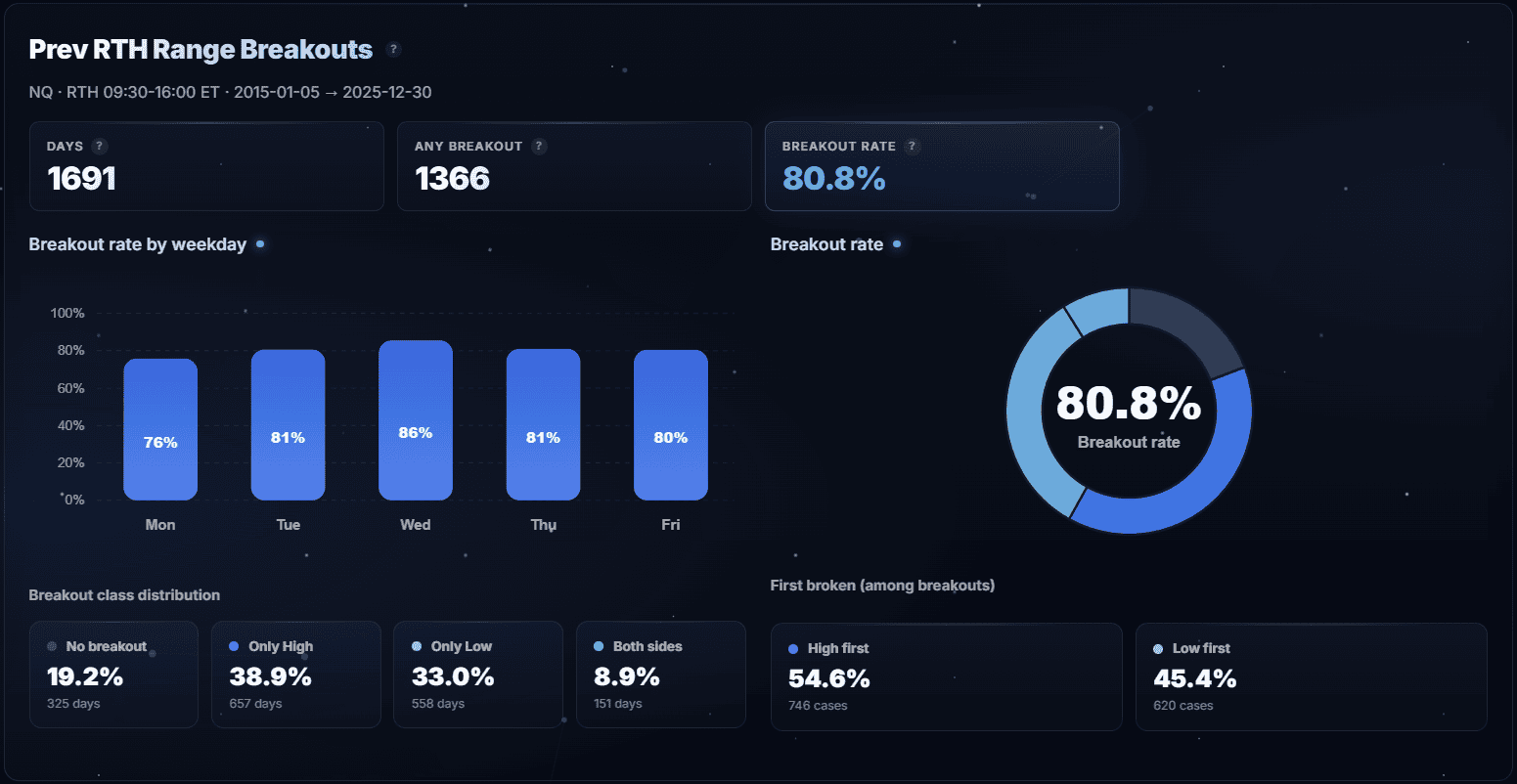
| Any breakout (high, low, or both) | 1,366 | 80.8% |
| Only high broken | 657 | 38.9% |
| Only low broken | 558 | 33.0% |
| Both levels broken | 151 | 8.9% |
| Neither level broken (inside day) | 325 | 19.2% |
The key number: on 80.8% of days, price breaks at least one of the previous day’s levels. That’s the baseline success rate for PDH/PDL breakouts — and it goes higher when you filter by specific conditions. The previous day’s range contains the entire session only about 19% of the time. Four out of five days, at least one level gives way.
The high is broken slightly more often than the low (47.8% of all days vs 41.9%). This reflects the long-term bullish bias of equity index futures across this 11-year sample.
Which Level Breaks First — High or Low?
Among the 1,366 days that had at least one breakout:
| First Level Broken | Count | % of Breakout Days | % of All Days |
|---|---|---|---|
| High first | 746 | 54.6% | 44.1% |
| Low first | 620 | 45.4% | 36.7% |
The 54.6/45.4 split toward high-first is consistent with an upward-trending market over this period — not dramatic, but persistent across 11 years of data.
Breakout Probability by Day of Week
Not all days are created equal:
| Day | Sample Size | Any Breakout | High First | Low First |
|---|---|---|---|---|
| Monday | 326 | 75.8% | 60.3% | 39.7% |
| Tuesday | 340 | 80.6% | 53.6% | 46.4% |
| Wednesday | 366 | 85.5% | 54.0% | 46.0% |
| Thursday | 331 | 81.0% | 53.7% | 46.3% |
| Friday | 328 | 80.5% | 51.9% | 48.1% |
Wednesday has the highest breakout rate at 85.5% — nearly 5 percentage points above the 80.8% baseline. Inside days are least common mid-week.
Monday has the lowest at 75.8%, about 5 points below baseline. After a weekend the market often consolidates as participants reassess positioning. Monday also shows the strongest high-first lean (60.3%) — when Monday breakouts do occur, they skew upside.
Friday is the most balanced directionally — a near 52/48 split between high-first and low-first, consistent with position-squaring ahead of the weekend.
Impact of Gap Direction
Does it matter whether the market opens higher or lower than yesterday’s close?
| Gap Direction | Sample Size | Any Breakout | High First | Low First |
|---|---|---|---|---|
| Gap Up | 887 | 78.9% | 66.3% | 33.7% |
| Gap Down | 780 | 82.8% | 41.6% | 58.4% |
Two findings. First, gap down days produce slightly more breakouts overall (82.8% vs 78.9%). Second, gap direction correlates strongly with which level breaks first. On gap up days, the high breaks first 66% of the time. On gap down days, the low breaks first 58% of the time. The market tends to continue in the direction of the gap.
Open Position Relative to Previous Midpoint
Where the market opens within yesterday’s range:
| Open Position | Sample Size | Any Breakout | High First | Low First |
|---|---|---|---|---|
| Above midpoint | 955 | 80.3% | 79.3% | 20.7% |
| Below midpoint | 732 | 81.4% | 23.0% | 77.0% |
The overall breakout rates are nearly identical (~80–81%), but the directional skew is massive. When the market opens above the previous midpoint, the high breaks first 79% of the time. Below midpoint — the low breaks first 77% of the time. The midpoint acts as a dividing line: whichever side the market opens on, that’s the side it’s more likely to break toward.
Open Relative to Previous Value Area
The Value Area adds another dimension:
| Open Position | Sample Size | Any Breakout | High First | Low First |
|---|---|---|---|---|
| Above Value Area | 453 | 83.2% | 84.4% | 15.6% |
| Inside Value Area | 886 | 77.1% | 55.1% | 44.9% |
| Below Value Area | 352 | 86.9% | 17.0% | 83.0% |
Opening outside the Value Area increases breakout probability and creates extreme directional skew. Above the VA: 83.2% breakout rate, 84.4% high-first. Below the VA: 86.9% breakout rate, 83.0% low-first.
Opening inside the VA produces the lowest breakout rate (77.1%) with the most balanced direction — this is when the market is most likely to stay range-bound.
Overnight Session Impact
What happens when the overnight session already touches one of yesterday’s levels before RTH opens?
| Overnight Activity | Sample Size | Any Breakout | vs. Baseline |
|---|---|---|---|
| No levels touched | 734 | 71.0% | −9.8 pts |
| Hit previous high | 505 | 88.7% | +7.9 pts |
| Hit previous low | 404 | 86.6% | +5.9 pts |
| Both levels hit | 48 | 97.9% | +17.1 pts |
This is the single most impactful factor in the dataset. When the overnight session touches neither level, the breakout rate drops to 71%. When it has already tested a level, RTH is far more likely to follow through — 88.7% when the overnight hit the high, 86.6% for the low.
When overnight hits both levels (rare — only 48 cases), a breakout during RTH is almost guaranteed at 97.9%.
Overnight tests don’t exhaust breakouts — they tend to confirm them. If the overnight session pushed toward a level, the RTH session typically follows through.
How Far Does Price Extend After a Breakout?
Knowing that a breakout occurs is one thing — knowing how far price typically travels beyond the level is another. We measure extension as a percentage of the previous day’s range.
Extension After High Breaks First (746 days)
| Time After Breakout | 25th Pctl | Median | 75th Pctl | 90th Pctl |
|---|---|---|---|---|
| 5 minutes | 3.4% | 6.8% | 12.7% | 20.1% |
| 15 minutes | 5.1% | 9.8% | 18.9% | 33.0% |
| 30 minutes | 6.6% | 13.0% | 25.3% | 42.2% |
| 1 hour | 8.7% | 16.9% | 32.1% | 52.5% |
| End of day | 15.4% | 31.1% | 60.8% | 93.9% |
Extension After Low Breaks First (620 days)
| Time After Breakout | 25th Pctl | Median | 75th Pctl | 90th Pctl |
|---|---|---|---|---|
| 5 minutes | 5.0% | 10.4% | 18.6% | 28.6% |
| 15 minutes | 7.8% | 15.7% | 27.1% | 42.7% |
| 30 minutes | 10.1% | 20.1% | 35.3% | 58.3% |
| 1 hour | 12.9% | 24.1% | 46.5% | 76.6% |
| End of day | 20.1% | 39.8% | 80.8% | 134.2% |
Low breakouts extend further than high breakouts across every time window. The median end-of-day extension is 39.8% of the previous range for low breakouts vs 31.1% for high breakouts. At the 90th percentile, low breakouts extend 134% of the previous range — more than yesterday’s entire range replayed to the downside. This asymmetry reflects a well-known property of equity markets: downside moves tend to be faster and more volatile than upside moves.
In concrete terms. If yesterday’s NQ range was 200 points and the high just broke, the median extension by end of day is about 62 points beyond the level (31.1% × 200). For a low breakout, the median is about 80 points (39.8% × 200). The 90th percentile high extension: ~188 points. Low extension: ~268 points.
High-Probability Multi-Condition Setups
Combining conditions reveals setups that significantly beat the baseline 80.8% breakout rate. Our analysis engine tests thousands of factor combinations and surfaces those with the highest breakout probability and sufficient sample size.
Best 2-Condition Setups
Gap Down + Overnight Hit Low → 94.7% breakout rate When the market gaps down AND the overnight session already touched the previous day’s low, 94.7% of the time a breakout occurs during RTH — 14 percentage points above baseline, across 189 occurrences. 88.8% of these are low-first.
Overnight Hit High + Open Above Value Area → 93.2% Overnight tests the previous high, today opens above yesterday’s Value Area. 93.2% breakout rate, 85.8% high-first. Sample: 250 days.
Gap Up + Overnight Hit High → 91.5% Gap up plus overnight high test. 91.5% breakout rate, 87.3% high-first. Sample: 258 days.
Best 3-Condition Setups
Below Midpoint + Gap Down + Overnight Hit Low → 94.6% Adding “open below midpoint” to the gap down + overnight hit low combination: 94.6% breakout rate, 89.1% low-first. Sample: 185 days.
Above Midpoint + Overnight Hit High + Above Value Area → 93.2% The upside equivalent: 93.2% breakout rate, 85.8% high-first. Sample: 250 days.
The Pattern
Every top-performing setup includes overnight confirmation — the overnight session having already tested the level in the direction of the eventual breakout. Combine that with gap direction and opening position, and breakout probability reaches 93–95% with strong directional skew.
When Breakouts Are Least Likely
On 19.2% of days — roughly one in five — price stays contained within the previous day’s range. These inside days cluster around specific conditions:
The overnight session hasn’t touched either level — 29.0% inside day rate vs 19.2% baseline. This is the single biggest predictor of range containment.
It’s a Monday — 24.2% inside day rate, consistent with post-weekend consolidation.
The open is inside the Value Area — 22.9% inside day rate, reflecting balanced conditions.
When multiple of these align, the probability of the market staying inside the previous range increases substantially.
Explore This Data Yourself
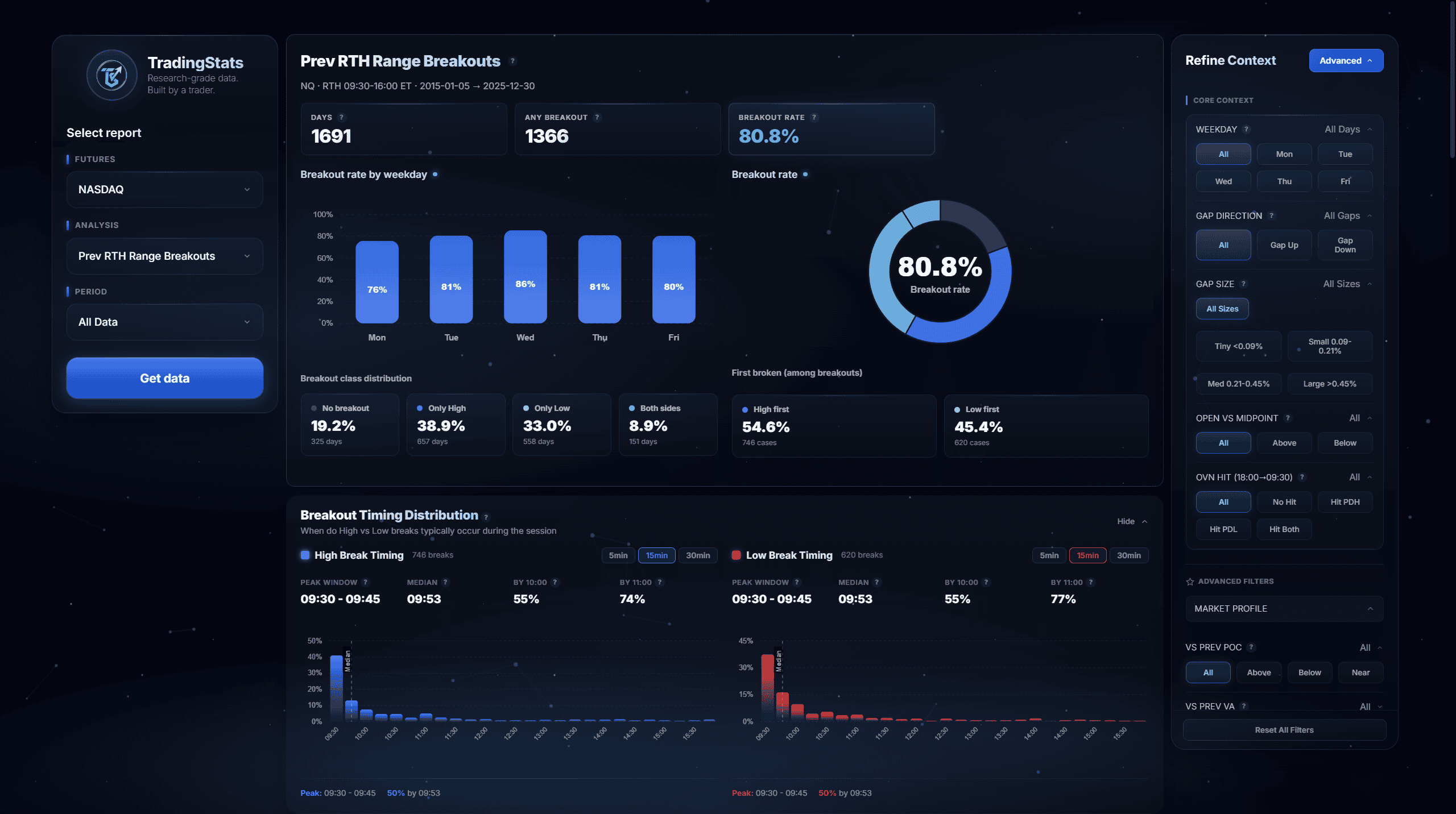
All the statistics in this article come from our Previous RTH Range Breakouts analysis tool. It runs these calculations for NQ, ES, YM, and other futures instruments with filters for every factor discussed above — day of week, gap direction, overnight activity, Value Area position, and more.
You can filter by custom date ranges, combine conditions, and explore how probabilities shift for specific contexts. Think of it as a PDH/PDL scanner that shows you the historical odds before the session opens.
Methodology
| Parameter | Value |
|---|---|
| Instrument | NQ (E-mini Nasdaq 100 futures) |
| Data period | Jan 5, 2015 – Dec 30, 2025 (1,691 qualifying days) |
| Session | RTH 9:30 AM – 4:00 PM Eastern Time |
| Overnight session | 6:00 PM – 9:30 AM ET |
| Breakout definition | Any RTH bar (excl. opening bar) trading above prev RTH high or below prev RTH low |
| Filter | Only days where RTH open is inside previous day’s RTH range |
| Gap classification | Gap up/down = open ± more than one tick (0.25 pts) from prev close |
| Gap size thresholds | Tiny: <0.09%, Small: 0.09–0.21%, Medium: 0.21–0.45%, Large: >0.45% |
| Extension | Max favorable excursion at 5min, 15min, 30min, 1hr, EOD after breakout bar (% of prev range) |
| Min sample sizes | 2-condition: ≥101 days, 3-condition: ≥67, 4-condition: ≥50 |
| TPO data | POC and Value Area from daily TPO profiles |
FAQ
How often does price break the previous day high?
In our NQ futures dataset, price breaks above the previous RTH high on 47.8% of qualifying days (38.9% only high + 8.9% both levels). At least one level is broken on 80.8% of days.
What is PDH and PDL in trading?
PDH stands for Previous Day High, PDL for Previous Day Low. These are the high and low of the previous regular trading session — levels where yesterday’s price action was rejected in each direction.
How often does the market stay inside the previous day’s range?
On 19.2% of days — neither the high nor the low is broken. Inside days are most common on Mondays (24.2%) and when the overnight session hasn’t tested either level (29.0%).
What is the best day of week for PDH/PDL breakouts?
Wednesday at 85.5%, nearly 5 points above the 80.8% baseline. Monday has the lowest rate at 75.8%.
Does gap direction predict which level breaks?
Yes. Gap up days: high breaks first 66.3% of the time. Gap down days: low breaks first 58.4%.
What is the difference between PDH/PDL and Opening Range Breakout?
PDH/PDL uses the entire previous session’s high and low. Opening Range Breakout (ORB) uses the first 5–30 minutes of the current session. Different reference levels, different probability profiles.
How far does price typically extend after breaking the previous day high?
Median end-of-day extension: 31.1% of the previous day’s range. For a 200-point NQ range, that’s about 62 points beyond the level. 90th percentile: 93.9% (~188 points).
Does overnight activity affect breakout probability?
Significantly. No overnight test: 71.0% breakout rate. Overnight hit the high: 88.7%. Both levels tested: 97.9%.