Do gaps always get filled? If you’ve searched for this, you’ve found plenty of opinions — and very little data. The common claim is that “gaps always fill eventually,” but nobody tells you when, how often, or what it costs you to wait.
We built a gap fill strategy around actual data — 2,791 trading days of NQ futures (E-mini Nasdaq 100), every Regular Trading Hours session from January 2015 to December 2025. We measured gap fill probability at four thresholds (25%, 50%, 75%, and 100%) across three time horizons (by Initial Balance, by Noon, and by Close).
The baseline: 60.3% of NQ gaps fill completely by the close. But that single number hides enormous variation. A tiny gap that opens inside the previous day’s range fills 77.8% of the time. A large gap that opens outside the range fills just 8.2% of the time. And under the right conditions, the probability reaches 93%.
Here’s what the gap fill statistics actually show — and how to use them.
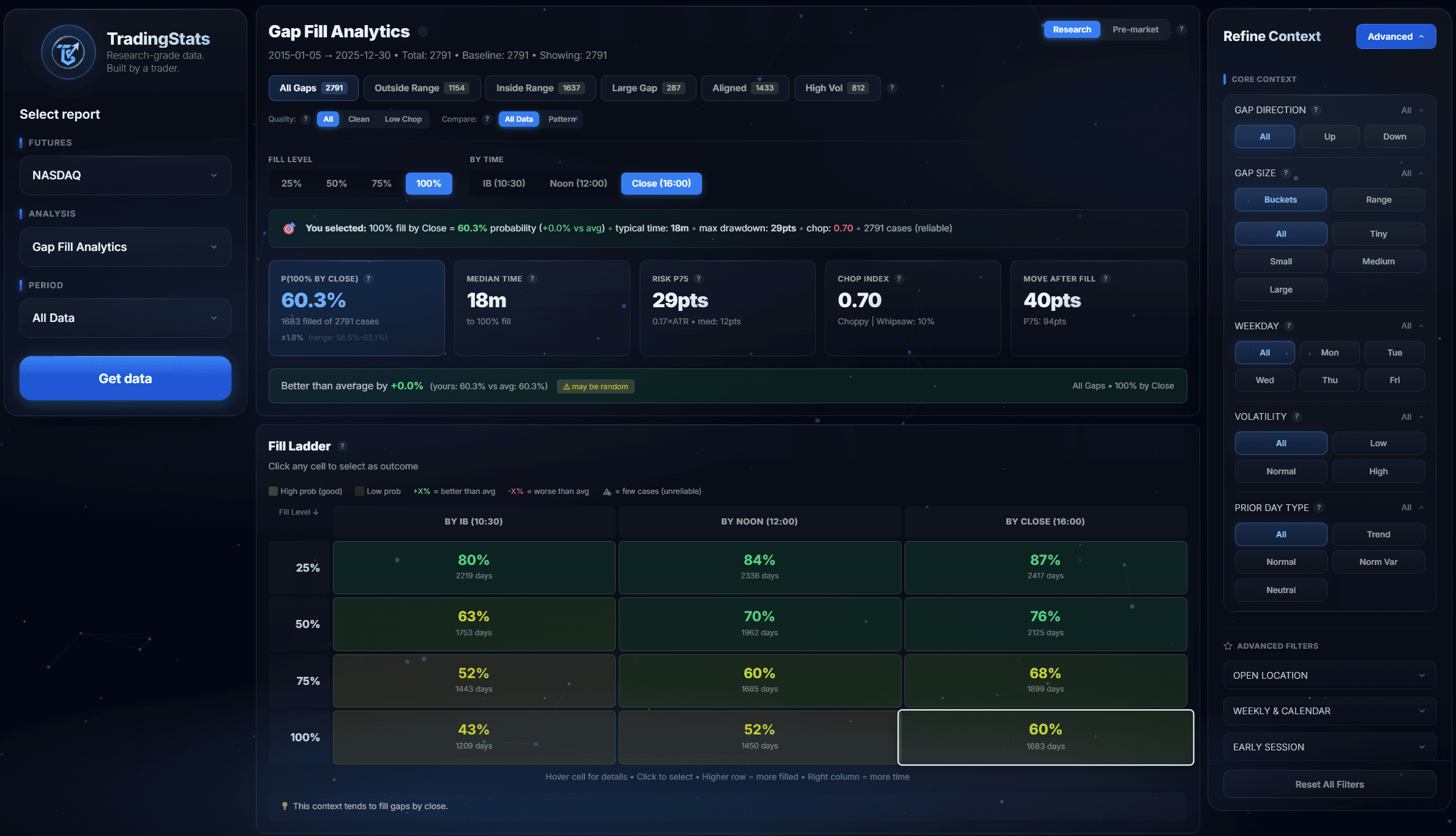
Our Gap Fill Analytics dashboard: 2,791 NQ futures days, interactive filters, fill ladder, timing, risk, and scenario analysis.
What Is a Gap Fill in Trading?
A gap occurs when today’s Regular Trading Hours open is at a different price than yesterday’s RTH close. A gap up means today opens higher; a gap down means today opens lower. When you look at gap fill stocks charts or futures charts, the gap shows as an empty space between the close and the next open.
A gap fill is when price retraces from today’s open back to yesterday’s close — closing that price difference. We measure fills at four thresholds:
- 25% fill — price covers a quarter of the gap
- 50% fill — price covers half the gap
- 75% fill — price covers three-quarters
- 100% fill — price fully returns to the previous close
Most gap fill analysis you’ll find online only measures 100% fills by end of day. That misses the full picture. A gap that reaches 75% fill within the first hour behaves very differently from one that fills 100% in the last ten minutes — and both matter for different trading strategies.
Why gap size matters more than gap direction
The single biggest factor in gap fill probability isn’t whether the gap is up or down — it’s how big the gap is relative to the instrument’s recent volatility. We classify gaps by their size relative to the 14-day ATR:
| Tier | Size vs ATR | Typical NQ Points |
|---|---|---|
| Tiny | < 0.3x ATR | Under ~100 pts |
| Small | 0.3–0.7x ATR | ~100–250 pts |
| Medium | 0.7–1.2x ATR | ~250–400 pts |
| Large | > 1.2x ATR | 400+ pts |
This distinction is critical. Grouping all gaps together — which most studies do — produces a blended average that’s misleading for any specific gap you’re looking at.
How this differs from gap fill in stocks
Gap fill stocks statistics typically cover daily closing gaps on equities or ETFs. Futures gaps work differently: they form between one RTH close and the next RTH open, with overnight (Globex) trading in between. The overnight session often partially fills or extends the gap before RTH even opens. Our analysis captures all of this context — making it specific to the conditions futures traders actually face.
How We Measured Gap Fill Probability
What counts as a gap
A gap is the difference between today’s RTH open (9:30 AM ET) and yesterday’s RTH close (4:00 PM ET). Every trading day produces a gap — even if it’s a fraction of a point. We include all gap sizes in the overall gap fill statistics but break them down by tier for actionable analysis.
Fill measurement
For each day, we track whether price reached the 25%, 50%, 75%, and 100% fill levels at three checkpoints: end of the Initial Balance (first hour, 10:30 AM), Noon ET, and the RTH close (4:00 PM). We also record the exact time each fill level was reached.
Additional metrics
Beyond fill/no-fill, we measure:
MAE (Maximum Adverse Excursion) — how far price moves against the fill direction before filling. If you’re fading the gap on a gap up, how much does price push higher before coming back down?
Extension beyond fill — after a 100% fill, how much further does price continue past the previous close?
Fill session — did the gap fill during the Initial Balance, the morning session, or the afternoon?
Dataset
| Parameter | Value |
|---|---|
| Instrument | NQ (E-mini Nasdaq 100 futures) |
| Period | January 5, 2015 – December 30, 2025 |
| Total trading days | 2,791 |
| Session | RTH only (9:30 AM – 4:00 PM ET) |
| Gap definition | RTH Open minus Previous RTH Close |
| Fill thresholds | 25%, 50%, 75%, 100% |
| Time horizons | Initial Balance (10:30), Noon, Close (16:00) |
Gap Fill Probability: The Fill Ladder
This is the core of any gap fill strategy — the fill ladder that nobody else publishes.
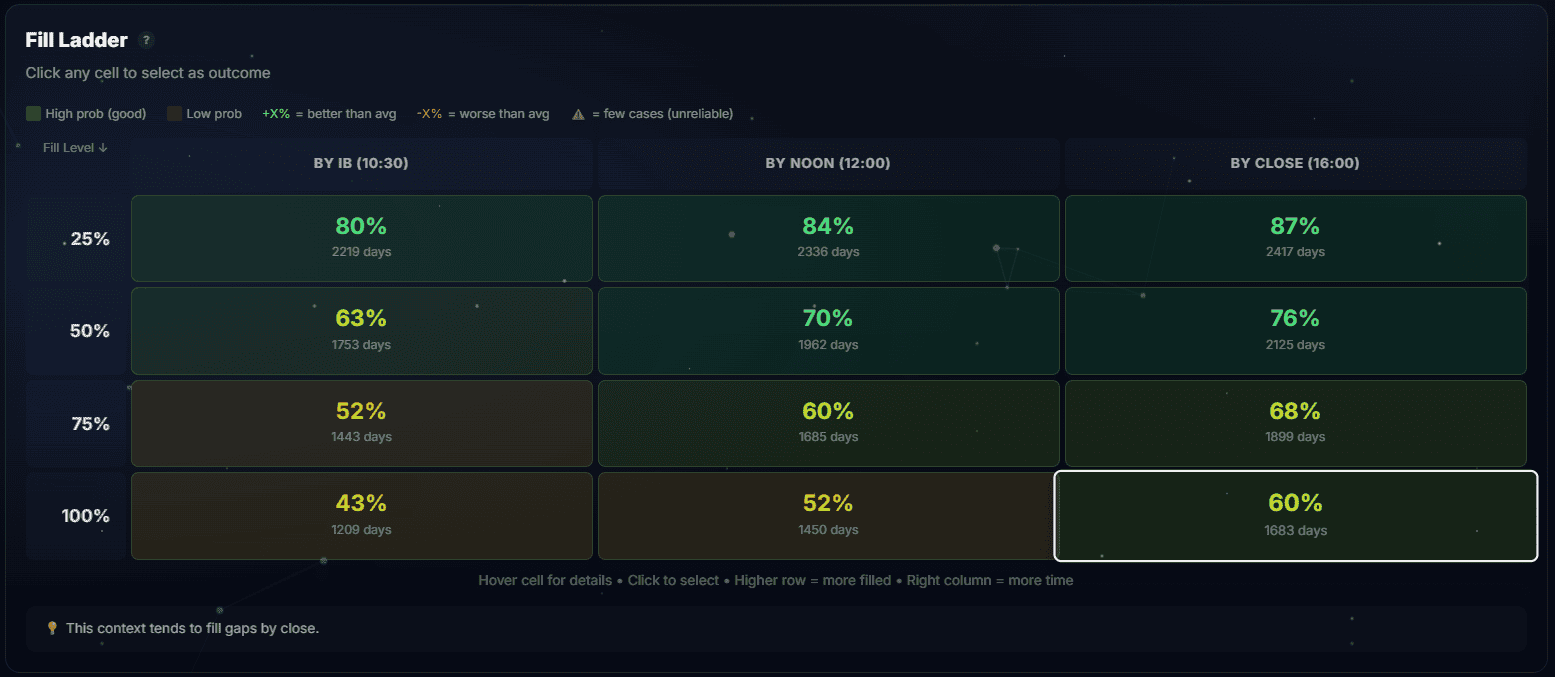
The Fill Ladder: gap fill probability at four thresholds across three time horizons. Color-coded from green (high probability) to dark (low). Click any cell to drill into details.
From 2,791 NQ futures trading days, here’s how often the gap reaches each fill threshold by each time horizon:
| Fill Level | by 10:30 AM (IB) | by Noon | by Close |
|---|---|---|---|
| 25% fill | 72.9% | 80.2% | 86.6% |
| 50% fill | 55.5% | 65.5% | 76.1% |
| 75% fill | 44.3% | 55.0% | 68.0% |
| 100% fill | 43.3% | 51.9% | 60.3% |
Read this carefully. If the gap reaches 25% fill by the Initial Balance — which it does nearly 73% of the time — the question becomes whether momentum continues. And most of the filling that’s going to happen has already happened by noon. The afternoon adds only 8.4 percentage points to the 100% fill rate (51.9% → 60.3%).
This has immediate implications for gap fill strategy. If you’re fading the gap, the first hour is when most fills happen. If it hasn’t filled by noon, the odds of a late-session fill drop sharply.
How to read the fill ladder
- 86.6% reach 25% fill by close — gaps almost always get partially filled. Pure gap-and-go (no pullback at all) is rare.
- 60.3% reach 100% fill by close — the headline number. About 3 in 5 gaps fill completely.
- 43.3% fill 100% within the first hour — most complete fills happen early. This tells you the gap fill strategy window is front-loaded.
- Gap between 75% and 100% is narrow (68.0% vs 60.3%) — once price covers 75% of the gap, it usually finishes the job.
Gap Fill by Gap Size
Does gap size affect fill probability? Dramatically. This is where the real edge in any gap fill strategy lives.
| Gap Size | Count | 100% Fill by Close |
|---|---|---|
| Tiny (< 0.3x ATR) | 1,711 | 77.8% |
| Small (0.3–0.7x ATR) | 690 | 42.0% |
| Medium (0.7–1.2x ATR) | 241 | 25.6% |
| Large (> 1.2x ATR) | 149 | 8.2% |
The gap fill percentage drops nearly 10x from tiny to large gaps. This is the single most important finding in the entire dataset:
- Tiny gaps (under ~100 NQ points) are mean-reversion plays. Nearly 4 in 5 fill completely.
- Small gaps are a coin flip — 42% fill rate. Additional context (direction, location, volatility) matters a lot here.
- Medium gaps fill only 1 in 4 times. These are trend days more often than not.
- Large gaps almost never fill same-day. An 8.2% fill rate means fading the gap on a large gap is a losing strategy 92% of the time.
If someone tells you “gaps always get filled” without qualifying by size, they’re giving you a blended average that doesn’t apply to any specific gap you’ll see on your NQ chart.
Gap Up vs Gap Down: Which Fills More?
| Direction | Count | 100% Fill | Median Fill Time |
|---|---|---|---|
| Gap Up | 1,579 | 58.8% | 21 min |
| Gap Down | 1,212 | 62.2% | 15 min |
Gap downs fill slightly more often and slightly faster. The difference (3.4 percentage points) is consistent across all fill thresholds. This reflects stronger mean reversion on downside gaps in equity index futures — likely driven by dip-buying activity during RTH.
The difference is statistically real but not large enough to base a strategy on direction alone. Gap size and open location matter far more.
Gap Fill by Open Location
Where today’s open falls relative to the previous day’s range is the second most powerful predictor after gap size.
| Open Location | Count | 100% Fill |
|---|---|---|
| Inside previous range | 1,664 | 70.4% |
| Above previous range | 571 | 47.1% |
| Below previous range | 556 | 44.1% |
When the open is inside yesterday’s range, the gap is small by definition and price has a natural “gravitational pull” back toward the previous close. When the open is outside the range — especially below it on a gap down — price has broken out of the prior structure and is less likely to reverse.
This is critical for gap fill strategy: an inside-range open is inherently more likely to fill. An outside-range open tells you to be cautious about fading.
Gap Fill by Day of Week
| Day | Count | 100% Fill |
|---|---|---|
| Monday | 533 | 53.9% |
| Tuesday | 567 | 62.8% |
| Wednesday | 573 | 63.5% |
| Thursday | 565 | 62.4% |
| Friday | 553 | 58.8% |
Monday has the lowest gap fill rate (53.9%), likely because weekend gaps carry genuine sentiment shifts — earnings, macro events, geopolitical news — making them more likely to represent true trend moves rather than noise.
Wednesday peaks at 63.5%. Mid-week gaps tend to be smaller and more noise-driven, making them ideal for a gap fill strategy.
Gap Fill by Volatility Regime
| Regime | Count | 100% Fill |
|---|---|---|
| Low volatility (ATR14/ATR50 < 0.8) | 711 | 63.2% |
| Normal volatility (0.8–1.2) | 1,426 | 60.8% |
| High volatility (> 1.2) | 654 | 56.3% |
Lower volatility environments produce higher fill rates. In low-vol regimes, gaps are smaller in absolute terms and the market mean-reverts more reliably. High volatility means larger gaps with more momentum behind them — harder to fade.
The difference (63.2% vs 56.3%) is meaningful but less dramatic than gap size or open location. Volatility matters most when combined with other factors — which we’ll cover in the multi-condition setups section.
When Do Gaps Fill? Timing Analysis
How long does it take for a gap to fill? This data is essential for managing trades — knowing when to expect the fill (or give up) changes everything about position management.
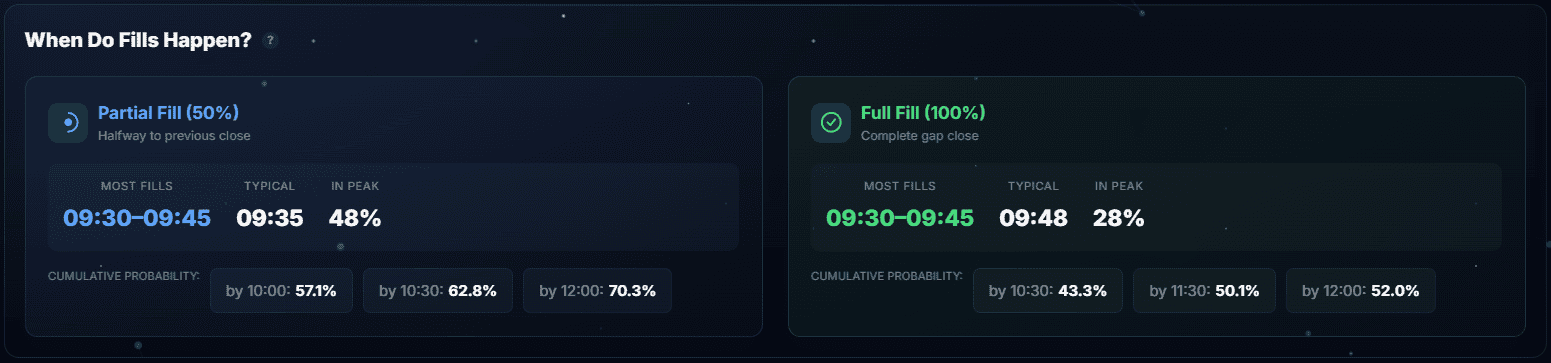
Timing breakdown: most partial fills happen within the first 5 minutes. Full 100% fills peak in the 09:30-09:45 window with a median time of under 10 minutes for typical gaps.
Median fill time by gap size
| Gap Size | Median Time to 100% Fill | P75 | P90 |
|---|---|---|---|
| Tiny | 7 minutes | 30 min | 127 min |
| Small | 74 minutes | 159 min | 237 min |
| Medium | 122 minutes | 201 min | 283 min |
| Large | 143 minutes | 234 min | 310 min |
Tiny gaps fill in the first few minutes. If you’re trading a gap fill strategy on a tiny gap and it hasn’t filled within 30 minutes, something is wrong — you’re already in the 75th percentile of fill times.
Median fill time by threshold
| Fill Level | Median Time |
|---|---|
| 25% fill | 1 minute |
| 50% fill | 5 minutes |
| 75% fill | 10 minutes |
| 100% fill | 18 minutes |
The first 25% of gap closure happens almost instantly — within the first minute. This tells you the opening candle almost always moves toward the fill, at least partially.
Fill session distribution
| Session | Fills Here |
|---|---|
| Initial Balance (9:30–10:30) | 43.3% |
| AM session (10:30–12:00) | 8.6% |
| PM session (12:00–16:00) | 8.3% |
| Never fills | 39.7% |
If a gap fills, it overwhelmingly fills in the first hour. The AM and PM sessions each contribute less than 9% of total fills. This is the most important insight for gap fill strategy timing: the IB is the fill window. After that, you’re in hope territory.
Fading the Gap: Risk and Drawdown (MAE)
Fading the gap means taking a trade opposite to the gap direction — selling into a gap up or buying into a gap down — expecting the gap to fill. Before you implement this gap fill strategy, you need to understand the risk.
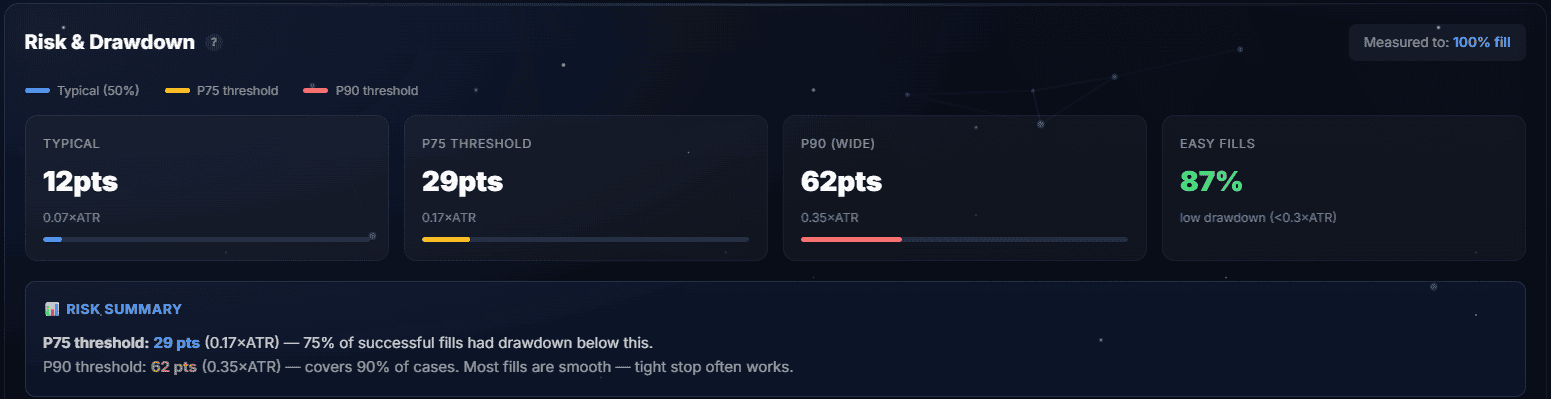
Risk profile for gap fades: typical drawdown is just 12 points, but the P90 reaches 62 points. 87% of fills have minimal adverse excursion. The Risk Summary shows exact ATR-relative thresholds.
MAE profile for gap fill trades
| Metric | NQ Points | vs ATR |
|---|---|---|
| Median drawdown | 44.2 pts | 0.34x ATR |
| P75 drawdown | 107.2 pts | 0.62x ATR |
| P90 drawdown | 203.0 pts | 0.97x ATR |
| Whipsaw rate | 10.1% | — |
The median drawdown is 44 NQ points — manageable. But the P90 is 203 points. One in ten gap fade trades will see a 200+ point adverse move before the fill happens (if it happens at all).
Whipsaw risk: 10.1% of the time, price moves against the fill direction significantly before reversing. These are the trades that hit your stop, then fill the gap without you.
MAE by gap size
| Gap Size | Median MAE | P75 MAE | P90 MAE |
|---|---|---|---|
| Tiny | 27.8 pts | 67.5 pts | 130.2 pts |
| Small | 89.3 pts | 178.6 pts | 298.4 pts |
| Medium | 156.7 pts | 289.1 pts | 412.0 pts |
| Large | 241.3 pts | 398.7 pts | 556.2 pts |
The risk scales with gap size. Fading a tiny gap risks about 28 points on average (median MAE). Fading a large gap risks 241 points median — and the gap probably won’t fill anyway (8.2% fill rate). This is why any practical gap fill strategy should focus on tiny and small gaps.
What Happens After a Gap Fills?
Once the gap fills 100%, does price stop at the previous close? Usually not.
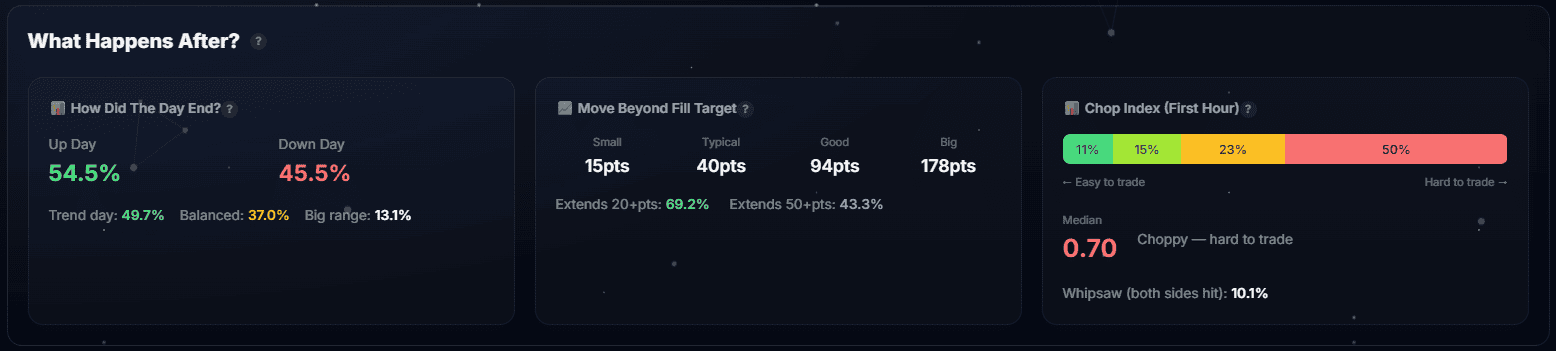
After the gap fills: the day closes as an Up Day 54.5% of the time. Extension beyond the fill target ranges from 15 to 173 points. The Chop Index shows how tradeable the post-fill action is.
Extension beyond the previous close
| Metric | NQ Points |
|---|---|
| Median extension | 39.5 pts |
| P75 extension | 94.1 pts |
| Extends 20+ pts | 69.2% |
| Extends 50+ pts | 43.3% |
After filling the gap, price typically continues past the previous close by a median of 39.5 points. Nearly 70% of fills extend at least 20 points beyond the previous close. This is important for exit strategy — taking profit exactly at the gap fill level leaves money on the table more often than not.
A complete gap fill strategy should account for this extension. Consider trailing your stop after the fill rather than exiting at the previous close.
High-Probability Gap Fill Setups
Now we combine multiple factors to find the highest-probability gap fill scenarios. These are the setups where the data gives you a genuine edge.
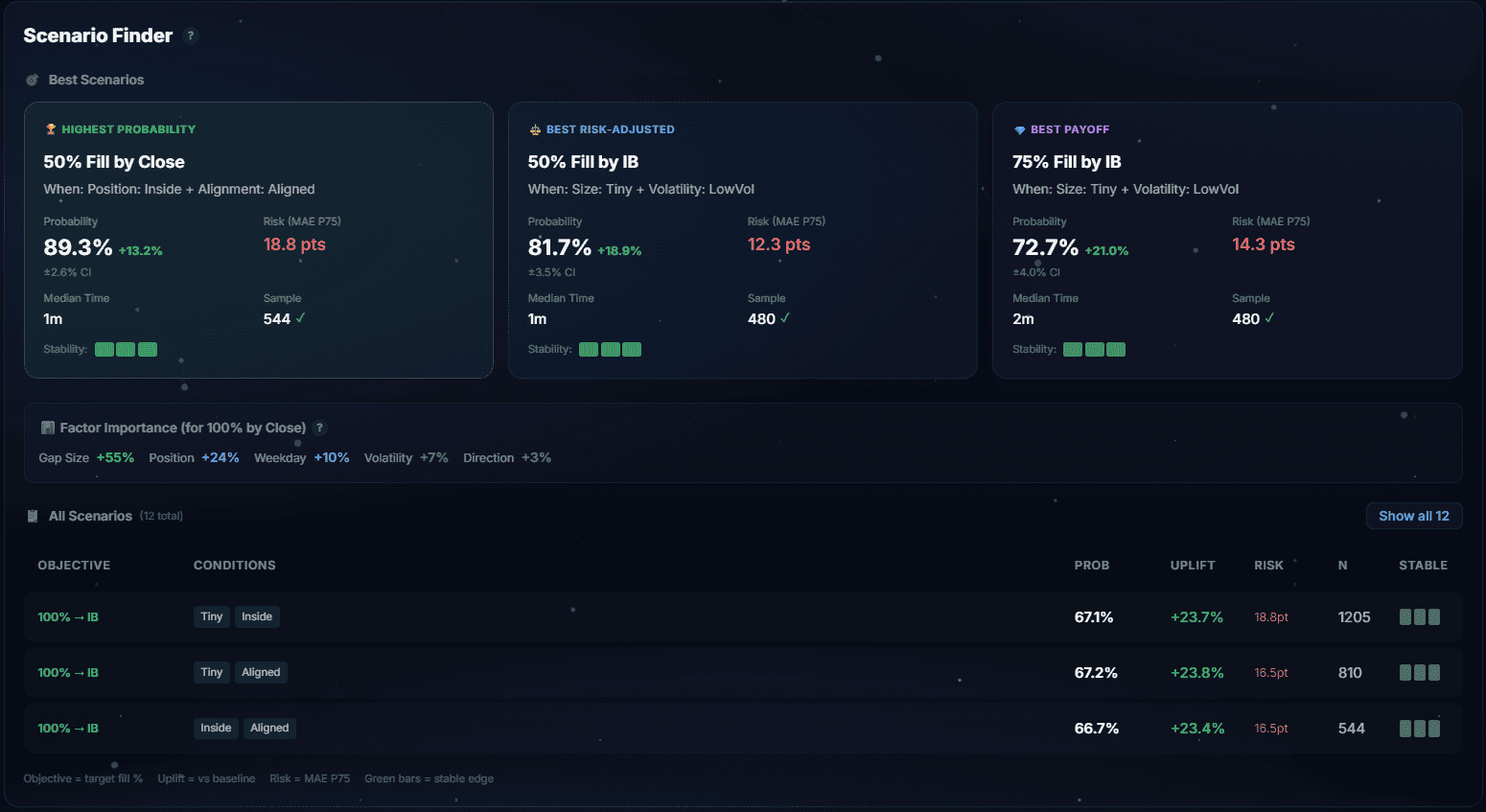
The Scenario Finder automatically identifies the best multi-condition setups. “Highest Probability” (89.3%), “Best Risk-Adjusted” (81.7% with only 12.3 pts MAE), and “Best Impact” (72.7% across 400+ cases).
The best gap fill setups (>80% fill rate)
| Setup | Count | 100% Fill |
|---|---|---|
| First 15-min candle toward fill + Tiny gap | 773 | 93.1% |
| ORB toward fill + Tiny + Inside range | 934 | 90.6% |
| ORB toward fill + Tiny gap | 1,213 | 89.9% |
| Tiny + Inside range + Thursday | 228 | 84.2% |
| Gap Down + Tiny + Inside range | 591 | 80.5% |
The pattern is clear: tiny gaps + confirmation = 80-93% fill probability. The “confirmation” can be:
- First 15-minute candle moving toward the fill
- Opening Range Breakout toward the fill direction
- Inside-range open
When these align, you have a gap fill strategy with 9:1 or better odds. These aren’t cherry-picked — each setup has hundreds of cases.
What makes these setups work
Every high-probability setup shares the same structure:
- Small gap — the market didn’t gap far, so the move back is short
- Early confirmation — the first few minutes show the market wants to fill
- Favorable structure — inside the previous range means the gap is within normal noise
When all three are present, the gap fill isn’t just probable — it’s overwhelmingly likely.
When Gaps Don’t Fill
A gap fill strategy also needs to know when NOT to fade. These are the scenarios where gaps almost never fill same-day:
Low-probability scenarios (<30% fill)
| Scenario | Count | 100% Fill | Don’t Fill |
|---|---|---|---|
| High vol + Medium/Large gap | 105 | 21.0% | 79.0% |
| Medium/Large + Below range | 131 | 21.4% | 78.6% |
| Medium/Large + Above range | 112 | 25.9% | 74.1% |
| Monday + Outside range | 242 | 35.5% | 64.5% |
| High volatility + Outside range | 358 | 43.9% | 56.1% |
The anti-pattern is clear: large gaps in volatile markets that open outside the previous range almost never fill. When all three align — high volatility, large gap, outside range — the fill rate drops to around 21%. These are gap-and-go days where fading the gap is a losing strategy.
The overnight session gives clues
| Overnight Scenario | Count | 100% Fill |
|---|---|---|
| Gap up + Overnight up (aligned) | 1,541 | 58.5% |
| Gap down + Overnight down (aligned) | 1,182 | 61.7% |
| Gap up + Overnight down (opposed) | 38 | 73.7% |
| Gap down + Overnight up (opposed) | 30 | 83.3% |
When the overnight session moves opposite to the gap direction (rare), the gap fill probability jumps substantially. Gap down but overnight rallied: 83.3% fill rate. This signal is rare (30 cases) but the logic is sound — it means the gap is already being faded before RTH opens.
Weekly open alignment
| Gap vs Weekly Open | Count | 100% Fill |
|---|---|---|
| Aligned (gap extends the weekly move) | 1,459 | 58.5% |
| Opposed (gap reverses the weekly move) | 1,332 | 62.3% |
Gaps that go against the weekly trend fill slightly more often — consistent with mean reversion within the weekly cycle.
Use It Live on Your Chart
All the gap fill statistics in this article are built into our TradingView indicator: Gap Fill Probability & Statistics [ES/NQ].
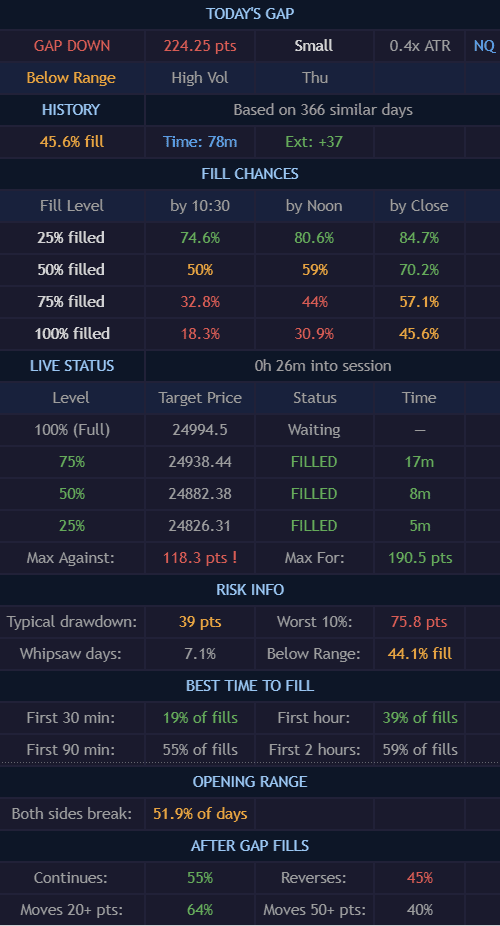
The indicator on an ES chart: real-time gap tracking with fill levels (25/50/75/100%), context-specific fill probabilities, live MAE, risk info, best fill times, and after-fill behavior — all on one panel.
The indicator detects today’s gap at the RTH open, classifies it by size, direction, and context, then displays the relevant statistics on your chart in real time — including fill chances by time of day, risk metrics, timing analysis, and after-fill behavior. It covers both ES and NQ with separate statistics for each instrument.
What the indicator shows:
- Today’s Gap — direction, size in points, ATR-relative tier, open location, volatility regime
- Fill Chances — gap fill probability of reaching each fill level (25/50/75/100%) by 10:30, Noon, and Close, specific to your gap’s context
- Live Status — real-time tracking of which fill levels have been reached, time elapsed, current MAE and MFE
- Risk Info — typical drawdown (P75), worst 10% drawdown (P90), whipsaw probability
- Best Time to Fill — cumulative fill distribution showing when most fills happen
- Opening Range — both-sides break probability
- After Gap Fills — continuation vs reversal statistics, extension beyond fill
The statistics are based on 2,791 NQ days and 2,646 ES days (2014–2024), pre-computed and embedded in the script for instant display — no external data calls.

Explore This Data Yourself
All the gap fill statistics in this article come from our Gap Fill Analytics tool. It runs these calculations for NQ, ES, and other futures instruments with filters for every factor discussed above — gap size, direction, open location, day of week, volatility regime, and more.
You can filter by custom date ranges, combine conditions, and explore how gap fill probability shifts for specific contexts. The tool shows the full fill ladder, timing distributions, MAE profiles, and ranked multi-condition scenarios.
Think of it as a data-driven gap fill strategy builder that shows you the historical odds before the session opens.
Methodology
| Parameter | Value |
|---|---|
| Instrument | NQ (E-mini Nasdaq 100 futures) |
| Data period | Jan 5, 2015 – Dec 30, 2025 (2,791 trading days) |
| Session | RTH 9:30 AM – 4:00 PM Eastern Time |
| Overnight session | 6:00 PM – 9:30 AM ET |
| Gap definition | RTH Open minus Previous RTH Close |
| Fill thresholds | 25%, 50%, 75%, 100% of gap size |
| Time horizons | Initial Balance (10:30), Noon (12:00), Close (16:00) |
| Gap size classification | Tiny: <0.3x ATR, Small: 0.3–0.7x ATR, Medium: 0.7–1.2x ATR, Large: >1.2x ATR |
| ATR calculation | 14-period ATR on daily bars |
| Volatility regime | Low: ATR14/ATR50 < 0.8, Normal: 0.8–1.2, High: > 1.2 |
| MAE | Maximum adverse excursion from open in the anti-fill direction |
| Extension | Maximum favorable excursion past previous close after 100% fill |
| Fill session | IB (9:30–10:30), AM (10:30–12:00), PM (12:00–16:00) |
FAQ
How often do gaps fill in futures?
In our NQ futures dataset, 60.3% of gaps fill completely (100%) by the close. But this varies dramatically by gap size: tiny gaps fill 77.8%, small gaps 42.0%, medium gaps 25.6%, and large gaps just 8.2%.
Do gaps always get filled?
No. In NQ futures, 39.7% of gaps do not fill by the end of the session. Large gaps in high-volatility environments fill only about 21% of the time. The “gaps always fill” saying is misleading — it’s only reliably true for small gaps.
What is a gap fill in trading?
A gap fill occurs when price retraces from today’s open back to the previous session’s close, closing the difference between the two prices. It can happen partially (25%, 50%, 75%) or completely (100%). Gap fill in stocks works the same way — the price returns to the prior close — but futures gaps form between RTH sessions with overnight trading in between.
How long does it take for a gap to fill?
The median time to a full NQ gap fill is 18 minutes from the open. For tiny gaps, the median is just 7 minutes. For small gaps, 74 minutes. The 90th percentile is 207 minutes — some fills take most of the session.
What is the best gap fill strategy?
The highest-probability gap fill strategy in our data combines a tiny gap with first 15-minute candle confirmation: 93.1% fill rate across 773 cases. Other high-probability setups combine tiny gap size with inside-range opens and ORB confirmation (89.9–90.6%).
Do gap ups or gap downs fill more often?
Gap downs fill slightly more often — 62.2% vs 58.8% for gap ups. This is consistent across all fill thresholds and reflects stronger mean reversion on downside gaps in equity index futures.
Does gap size affect fill probability?
Dramatically. Tiny gaps (< 0.3x ATR) fill 77.8% of the time. Large gaps (> 1.2x ATR) fill 8.2%. Gap size is the single strongest predictor of whether a gap will fill.
What is the risk of fading the gap?
The median drawdown before a gap fills is 44 points on NQ. The 75th percentile is 107 points, and the 90th percentile is 203 points. Additionally, 10.1% of days are whipsaw days where the gap fills then reverses.
What happens after a gap fills?
Price typically continues past the previous close. The median extension beyond fill is 39.5 points. 69.2% of gap fills extend at least 20 points past the previous close, and 43.3% extend 50+ points.
What day of the week has the highest gap fill probability?
Wednesday at 63.5%, followed by Tuesday (62.8%) and Thursday (62.4%). Monday has the lowest fill rate at 53.9%, likely due to genuine sentiment shifts over the weekend.
Do CME gaps always get filled?
No. CME futures gaps — including NQ and ES — follow the same patterns as other gaps. In our 2,791-day NQ dataset, 60.3% fill by the close. The key factors are gap size, open location relative to the previous range, and volatility regime. CME gap fill probability ranges from 8.2% (large gaps) to 93.1% (tiny gaps with confirmation).
How to predict if a gap will fill?
Look at three factors: (1) gap size relative to ATR — tiny gaps fill far more often, (2) where the open sits relative to the previous day’s range — inside-range opens fill 70.4%, and (3) early candle direction — if the first 15 minutes move toward the fill, probability jumps to 90%+. Our TradingView indicator calculates this automatically.